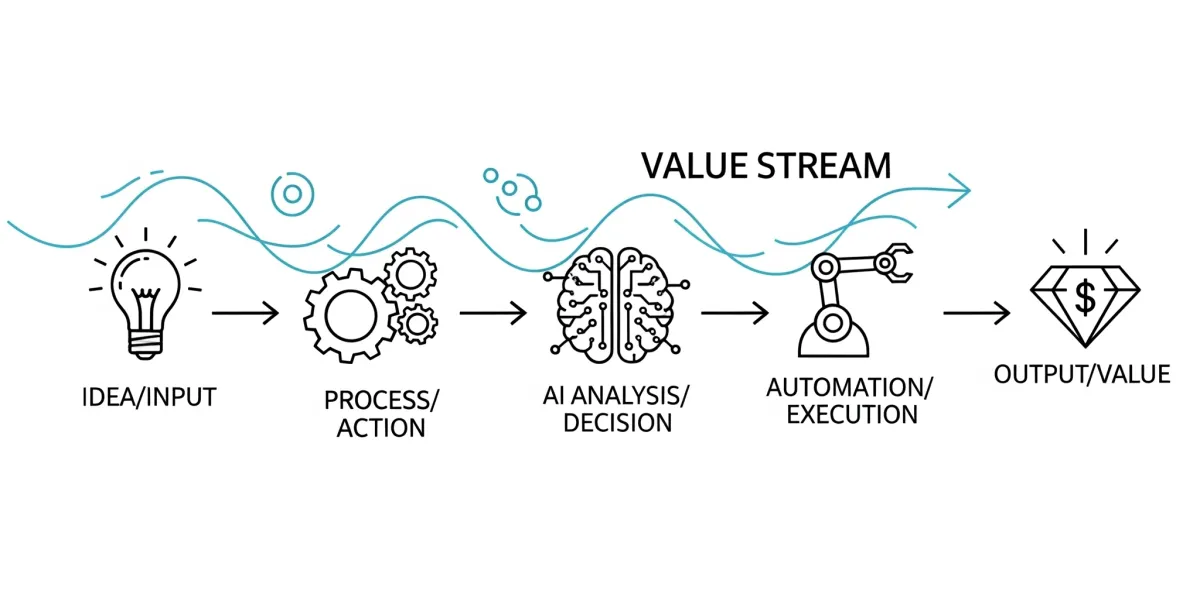
AI & Automation for Small Business: A Value Stream Guide
A Guide to How AI and Automation Can Super Charge Your Business
A Small Business Owner's Guide to Using Your Value Stream to Find the Right Opportunities for AI and Automation
As a small business owner, you're constantly juggling a thousand tasks. From managing inventory and marketing to customer service and payroll, it can feel like there aren't enough hours in the day. But what if there was a way to work smarter, not just harder? Enter Artificial Intelligence (AI) and automation, not just for tech giants but powerful tools that can revolutionize your small business.
Many small business owners might feel that AI and automation are complex, expensive, or simply "not for them." The truth is, these technologies are more accessible and affordable than ever. The key isn't to blindly adopt every new gadget, but to strategically identify where they can make the biggest impact. And the best way to do that? By looking at your value stream.
What is a Value Stream, and Why Does it Matter to You?
Simply put, a value stream is the entire sequence of activities your business undertakes to deliver a product or service to your customer. Think of it as a journey, from the moment a customer expresses interest to the final delivery and even after-sales support.
For example, if you own a bakery, your value stream might include:
Sourcing ingredients
Baking the products
Packaging
Marketing and sales
Taking orders
Customer service
Delivery or in-store pickup
Understanding your value stream is crucial because it helps you visualize every step, identify bottlenecks, wasteful activities, and areas where you might be losing time or money. It's the roadmap to efficiency.

How to Analyze Your Value Stream for AI and Automation Opportunities
Here's a step-by-step guide to help you uncover where AI and automation can best serve your business:
Step 1: Map Out Your Current Value Stream
Grab a whiteboard, a large piece of paper, or even a digital tool, and literally draw out every single step involved in delivering your product or service. Be granular. Don't skip anything, no matter how small it seems.
What triggers the process? (e.g., a customer inquiry, a new order)
What happens next?
Who is involved at each stage?
What tools or software do you use?
How long does each step take?
Step 2: Identify Bottlenecks and Repetitive Tasks
Once you have your value stream mapped out, put on your detective hat.
Where do things slow down? These are your bottlenecks. Is it order processing? Customer inquiries? Inventory management?
What tasks are highly repetitive? Are you manually entering data? Answering the same customer questions repeatedly? Sending out routine emails? These are prime candidates for automation.
Where are errors most common? Manual processes often lead to human error. AI can often perform these tasks with greater accuracy.
Where do you spend the most time (and money)? High-cost, time-consuming activities are also great places to look.
Step 3: Brainstorm AI and Automation Solutions
Now that you've identified the "pain points," let's explore how AI and automation can help. Here are some common areas and examples:
Customer Service:
Automation: Chatbots can handle frequently asked questions (FAQs) 24/7, freeing up your team for more complex issues.
AI: AI-powered tools can analyze customer sentiment from reviews or emails, helping you quickly identify satisfaction levels and areas for improvement.
Marketing and Sales:
Automation: Email marketing platforms can send automated follow-ups, birthday wishes, or abandoned cart reminders. CRM (Customer Relationship Management) systems automate lead tracking and customer communication.
AI: AI can analyze customer data to identify buying patterns, predict future purchases, and personalize marketing messages for higher conversion rates. AI-powered ad platforms can optimize your ad spend by targeting the most relevant audiences.
Operations and Back Office:
Automation: Automate invoice processing, payroll, and expense tracking. Tools can automatically update inventory levels when a sale is made.
AI: AI can forecast demand for your products, helping you optimize inventory and reduce waste. For manufacturing, AI can even monitor equipment for predictive maintenance, preventing costly breakdowns.
Data Analysis:
AI: Instead of sifting through spreadsheets for hours, AI tools can quickly analyze large datasets to uncover trends, provide insights into customer behavior, or identify inefficiencies in your operations.
Step 4: Prioritize and Start Small
It can be tempting to try and automate everything at once, but that's a recipe for overwhelm.
Prioritize: Focus on the areas that cause the most pain, consume the most time, or have the highest potential for return on investment (ROI).
Start Small: Choose one or two manageable tasks to automate first. This allows you to learn the ropes, see tangible results, and build confidence before tackling bigger projects. For example, setting up an automated email sequence is a great starting point.
Measure: Track the impact of your changes. Are you saving time? Reducing costs? Improving customer satisfaction?
The Future is Automated, Even for Small Businesses
Embracing AI and automation isn't about replacing human workers; it's about empowering them to focus on higher-value, more creative, and strategic tasks. It's about making your small business more resilient, more competitive, and more profitable.
By taking the time to understand your value stream, you gain a powerful lens through which to view your operations. This clarity will guide you in strategically adopting AI and automation, ensuring that every technological investment genuinely moves your business forward. Don't be left behind; start exploring the possibilities today.
Return to Nexus North home.

